
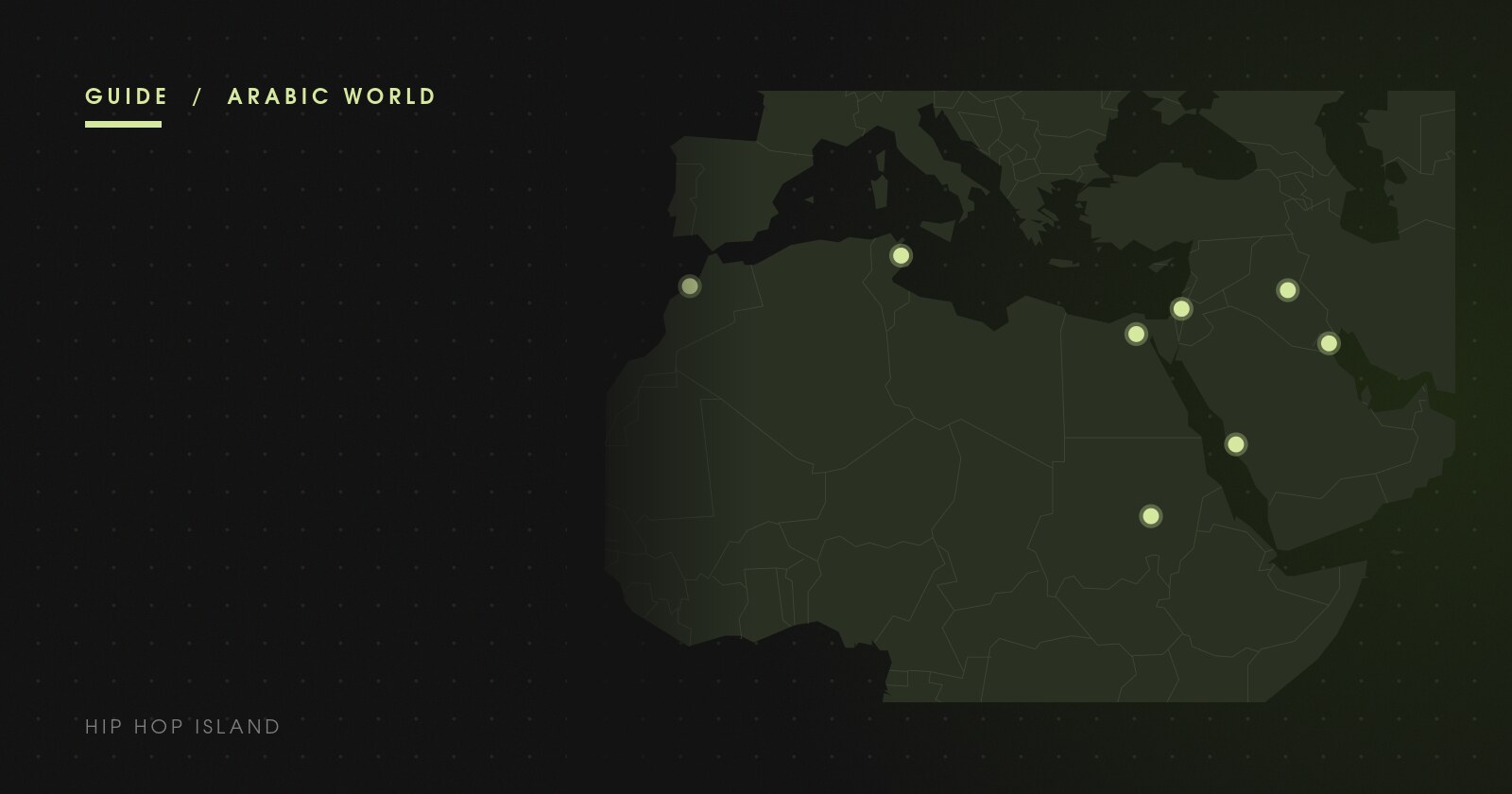
Arabic-language rap has moved from the margins to the centre of regional pop in less than a decade. Rolling Stone MENA says Arabic music has surged since around 2018, producing global breakouts and a revived regional industry, and rap is one of the clearest examples. This guide maps the scenes that make it up, from Cairo to Casablanca to Baghdad, and points to artists on Hip Hop Island who show each one.
Trap meets tradition
Arab America describes Arab trap as an underground movement that has grown into a global phenomenon over roughly the past decade. In the late 2010s, it says, musicians began mixing trap with the oud, qanun and ney, and with samples of Umm Kulthum and Fairuz; producers also sample or recreate the darbuka and mizmar. Songs are often in Arabic and regional dialects and address social and political issues. The article credits streaming playlists, Instagram and TikTok challenges, and collaborations with Western artists with widening the audience. Rolling Stone MENA makes a similar point in its Future Radar 2026 list: artists increasingly draw on tradition, such as maqamat and tarab, while experimenting with modern production.
Egypt: shaabi rap and mahraganat
Rolling Stone MENA says shaabi rap is dominating Egypt while mahraganat is being pushed towards pop. Arab America lists Marwan Pablo, Wegz and Marwan Moussa among the Egyptian names behind the trap sound, and describes mahraganat as electro-shaabi that fuses street energy with trap production. Rolling Stone MENA names Young Giza, who debuted in 2021 with “Tashleef” and makes heavy, dark, reggaeton-inflected rap, and Hassan Yasser, who blends hip-hop and trap with shaabi influences and a futuristic visual style. Its list also includes Mshref from Fayoum, who blends rap with mahraganat, and Seif Mrdeny, who makes socially aware shaabi rap. Hip Hop Island also profiles Marwan Pablo and TaffyRaps.
The Maghreb: raï, chaabi and Afrobeat
Rolling Stone MENA says Morocco’s new wave mixes rap with raï, Afrobeat and chaabi. It describes Casablanca’s Lhaj as Afrobeat-driven with raï undertones, Skotty1 as pairing smooth vocals with compressed beats, and Obito, whose debut album Bebetoo came out in 2025, as having a forceful, rapid-fire flow and a shadowy sound. Hip Hop Island profiles Obito and Loun from Morocco. In Tunisia, the same list highlights KOAST from Monastir, who fuses R&B, jazz and hip-hop with classical Arabic tarab, and LullySnake, who gained attention in 2024 with the shaabi-inflected “Zabatna Kida”. Algeria is represented here by TIF.
The Gulf: Kuwait and Saudi Arabia
Complex MENA describes OUZII as leading Kuwait’s rise in rap; his track “Atmashaa” went viral on TikTok in 2024. Rolling Stone MENA says Saudi Arabia has emerged with club rap, and highlights D7Z, whose “Abgha El Salama” (November 2025, MDLBEAST Records) shifted towards high-energy club rap that mixes techno beats with localised flows. Hip Hop Island profiles Asayel from Saudi Arabia.
Iraq, the Levant and Sudan
Som3a from Baghdad began making music in 2021 and, according to Rolling Stone MENA, fuses Iraqi maqamat with trap, mumble rap and dancehall. From Palestine, Touch started on SoundCloud in 2020 and released a debut EP, MSEBEH, with the backing of BLTNM Records. In Sudan, OkayAfrica highlights Soulja, whose song “Argeen” appeared on its best North African songs list for 2025, and Montiyago; it adds that Sudanese rap draws on a distinctive Arabic dialect that has struggled to gain a wider hearing across the region.
Newer voices on the radar
Rolling Stone MENA’s list gives dates that show how recent much of this wave is. Seif Mrdeny launched in 2023 with “Shaghalin Halal”; Burhan began rapping in 2023 with “3otared” and released the EP Beeny w Beeny; Mshref from Fayoum began pursuing music seriously in 2024; Skotty1 debuted with “Massira” in 2022 and has worked with Obito; Lhaj debuted with “13” in 2021 and released the EP UNDERDOG; and KOAST’s latest release is the 2026 EP 1609, following his debut EP B-Town Vol. 1 in 2019. Most of these artists have been releasing for three years or fewer.
Labels, borders and collaboration
Rolling Stone MENA notes that cross-border collaboration is widespread across Egypt, Morocco, Tunisia, Iraq, Kuwait and the Levant, and that independent and regional labels such as B62, Ra’ad, Drop, BLTNM and Tawleef are central to the scene. That matters for anyone searching for artists: in this region, a feature on a label’s compilation or a guest verse from a neighbouring country is often the first sign that an artist is being noticed.
How to listen
Start with one scene rather than the whole region. Egyptian shaabi rap is the most immediate for listeners used to trap; Moroccan and Tunisian rap rewards listeners who like raï or chaabi; and the Gulf scenes show how quickly TikTok can move a track. The Discover map lets you jump to any of these countries. Our profiles state each artist’s sources and listener numbers on the date we reviewed them, so you can see how established a name is before you press play.
Where rap ends and pop begins
The boundary is porous. Rolling Stone MENA includes several artists it does not strictly call rappers: Laila Beshara from Egypt, who uses club-rap and hyperpop tropes but also R&B, techno and drum and bass; Daro, who mixes R&B and trap; Msh3al, described as Sudanese-Saudi and Afrobeat-driven; and Shams from Syria, who formerly rapped as Thawra and now makes indie-pop. This is common across global hip-hop, and Hip Hop Island treats it the same way: an artist can be on the site if rap is a core part of their work, and we say in the profile when they have moved on, as with Diona in our Bulgarian guide.
A note on the sources
Lists such as Future Radar are editorial selections, not rankings, and they favour artists with some recent press. Many strong rappers in the region, especially outside Egypt and Morocco, get little English-language coverage, so a missing name here says nothing about quality. Where our own profiles are thin, we say so and we do not publish claims we cannot source.


