
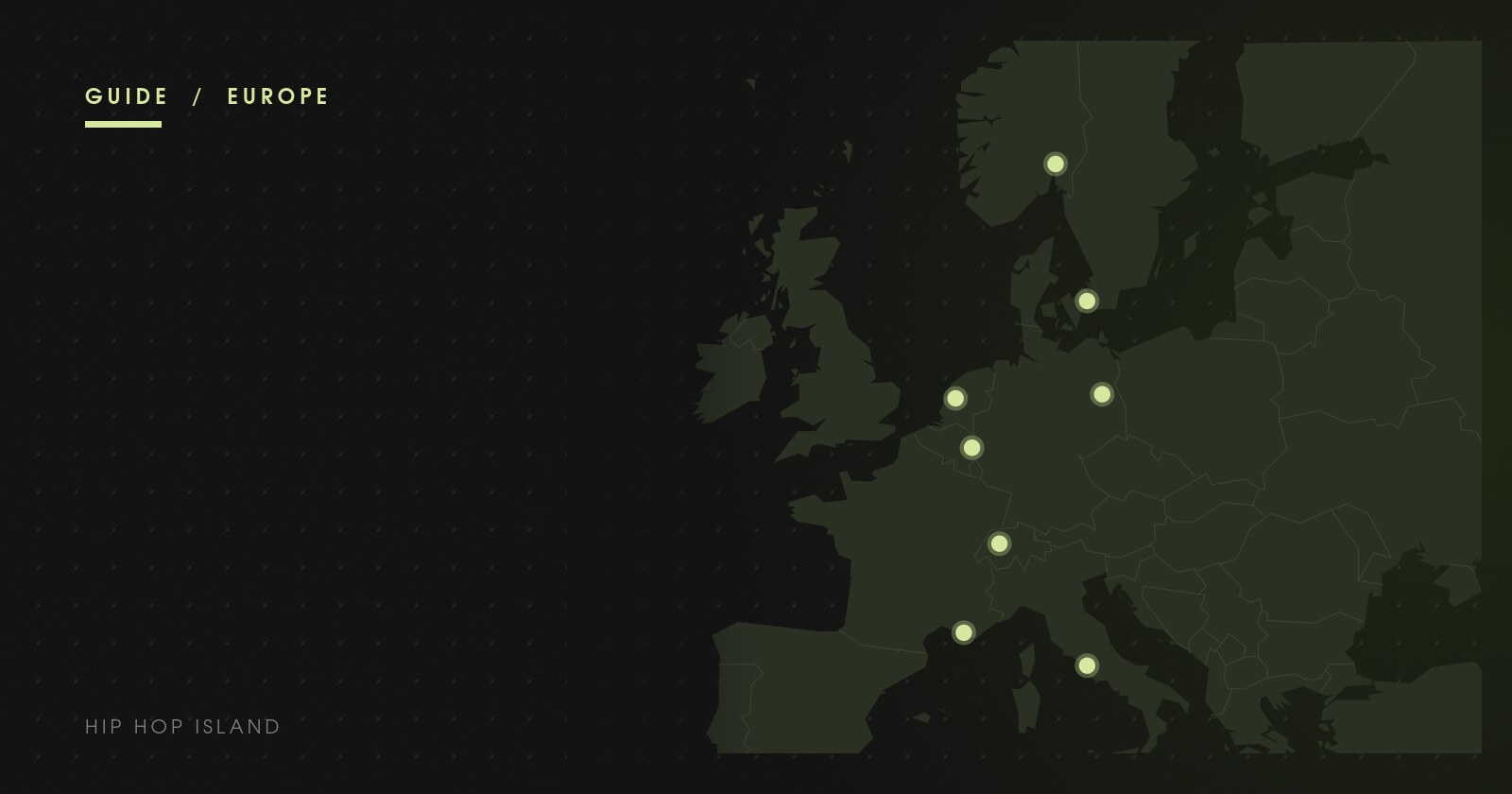
In much of Europe, rap is not an alternative to the mainstream: it is the mainstream, and it is mostly sung in the local language. This guide looks at the biggest markets, France and Germany, then the Italian, Dutch, Belgian, Swiss and Danish scenes, with figures from named sources and artists on Hip Hop Island who show where each one stands.
France: the second-largest rap market
A 2025 overview on Europavox Campus says the 1990s were French rap’s golden age, with IAM’s L’École du micro d’argent (1997) selling more than 1.6 million copies, and that rap has dominated French music since 2017: in 2024, twelve of the twenty best-selling albums were rap. It calls France the world’s second-largest rap market after the United States. The article does not name the sources of most of its figures, so treat them as indicative. Billboard’s earlier reporting shows how streaming changed the picture: Niska’s Mr Sal topped the French charts for five weeks, after Nekfeu held the top spot for eleven.
Germany: Deutschrap and its streaming records
Skoove and DataPulse Research analysed weekly Spotify Top 200 charts from 73 countries between May 2024 and July 2025 and found that hip-hop and rap accounted for 73% of German artists’ streaming success, far ahead of pop at 21%. German artists took 48% of Top 200 chart activity in Germany. Europavox adds that German-language hip-hop made up about one-fifth of industry revenue, with RAF Camora described as the most-streamed German musician of all time and Capital Bra’s Berlin lebt (2018) setting streaming records.
Italy: trap at home
The same Skoove analysis puts Italy at 83% local share of its Spotify Top 200, the highest of the countries it compared, and Billboard names Capo Plaza and Sfera Ebbasta among the leaders at home. On Hip Hop Island, Icy Subzero from Rome fits the pattern: according to our profile, his debut EP Sottozero (2022) went platinum and Anno Zero (2025) debuted at number five in Italy. Our guide to Italian female rap covers the women in that scene.
The Netherlands and Belgium
Billboard lists Boef among the leaders of Dutch-language hip-hop, and says local-language hip-hop was already almost half of hip-hop listening on Spotify in France, Germany and the Netherlands. Sevn Alias from Amsterdam, who broke through with a 2015 session on 101Barz, is one of the genre’s defining names. Across the border, Green Montana from Verviers is signed to Booba’s French label 92i and is among the most-streamed rappers in Belgium; Numero reported in 2022 that his style is soft and mumbled enough that he adds subtitles to his videos.
Switzerland and Denmark
Smaller markets show how far local language goes. Jule X raps in Bern dialect and, according to nau.ch, reached the Swiss charts with his 2024 EP Atzäpop; Blue News reports that he is now trying to take dialect rap to Germany. In Denmark, Zuloo sold out Lille VEGA in Copenhagen in under two months, according to SPOT Festival, and GAFFA gave his mixtape Motionboyz four stars. The Nordic picture is broader: Billboard cites Karpe in Norway and JVG in Finland as leaders at home, and Europavox says Norwegian rap is hybrid, with artists switching between Norwegian and English.
Eastern Europe
Europavox notes that rap in Lithuania and Romania grew in the 2000s and sales rose significantly in the 2010s, and that streaming has let independent artists reach wider audiences. In Romania, pop and manele still dominate the market but rap is steadily gaining ground and draws on Balkan music. Our own guide to Bulgarian rap to watch in 2026 looks at a neighbouring scene.
The business behind the charts
Billboard reports that streaming helped local-language hip-hop outperform global stars such as Drake and Ed Sheeran in several home markets, because platforms that favour local repertoire let a single album fill several chart positions, and that major labels responded by investing in local hip-hop and offering service-level deals that give artists more independence. Europavox frames the artist’s choice as English for global reach or the native language for national identity. Most of the artists above chose the second.
Where local rap gets covered
The most useful coverage of a European scene is usually in its own language. For this site we have drawn on the Dutch platform 101Barz for Sevn Alias, the French outlets Booska-P and Numéro for Green Montana, the Danish music magazine GAFFA for Zuloo, Swiss outlets nau.ch and Blue News for Jule X, the Italian outlets Donna Glamour and Exhimusic for Icy Subzero, and Vibes.bg and Podmosta for Bulgarian rap. If you want to follow a scene beyond this guide, those are good places to begin, and a translation tool will get you most of the way.
How to listen
If you speak none of these languages, start with the production and the delivery; the lyrics can follow. Begin with the artists above whose scenes are easiest to enter: Sevn Alias for Dutch, Green Montana for melodic French-language trap, Icy Subzero for Italian, and Jule X for the dialect rap that nobody outside Switzerland expects to like. The Discover map shows the rest.
A note on the figures
The Billboard feature predates 2026 and its figures describe the late 2010s; the Europavox overview does not cite most of its numbers; the Skoove analysis is a dataset of Spotify chart activity, not sales. We use them as context, not as rankings.
Sources
- Europavox Campus – The place of rap in the musical landscape of five European countries (21 Mar 2025)
- Billboard – Rap Goes Global, On A Local Level
- Skoove / DataPulse Research – Deutschrap dominates Germany’s Spotify charts (30 Aug 2025)
- Artist details: the sources listed on each linked Hip Hop Island profile.


