
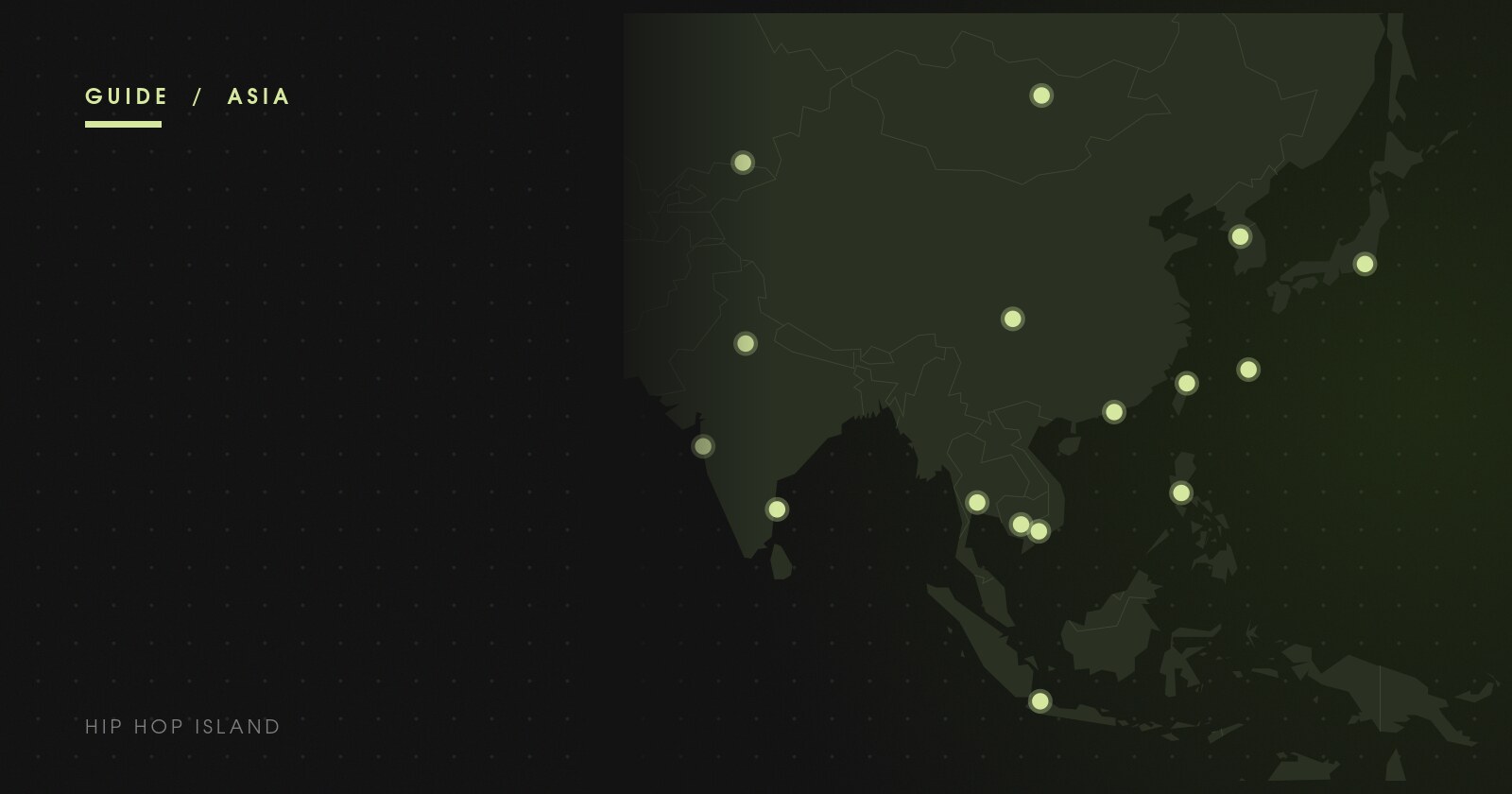
Asia’s hip-hop scenes rarely resemble each other: Okinawa’s bilingual rap, Chengdu’s Sichuan-dialect trap, Delhi’s underground, Manila’s battle leagues and Ulaanbaatar’s new generation. This guide groups them by region, explains what has driven each one, and links to artists on Hip Hop Island who show where the scenes are now.
What drove the boom
VIBE traces much of the recent attention to The Rap of China (2017), which brought Chinese rap to international attention before the US label 88rising developed Rich Brian and Higher Brothers. It also argues that hip-hop was already established in Thailand, Japan and Korea, and that local scenes in India, Indonesia and the Philippines now draw millions of YouTube views. Major labels followed: VIBE reports that Nas’s Mass Appeal opened in India and signed the pioneering rapper Divine, and that Def Jam launched Def Jam SE Asia and signed artists in several countries.
East Asia: Japan, Korea, China, Hong Kong and Taiwan
In Japan, Awich from Naha, Okinawa, raps in Japanese and English. She joined the Yentown collective in 2017, signed to Universal J in 2020, and her 2021 single “Gila Gila” was certified platinum for streaming by the RIAJ, according to our profile. LEX from Shōnan began by uploading a remix to SoundCloud, KAI-YOU reports. In South Korea, television competitions shape careers: Huh! competed in three seasons of Show Me The Money before becoming an independent artist, and Jessi finished second on Unpretty Rapstar in 2015.
In China, an AP report describes how censors in 2018 told the industry to avoid hip-hop and subcultures, how rap returned by year’s end after being rebranded as shuochang, a traditional storytelling form, and how Chengdu became the scene’s centre. Wang Yitai, Higher Brothers and Vava mix Mandarin with Sichuan dialect, which the article says suits rap because of its many rhymes. Artists now promote music through short clips on Douyin, since underground battles in Chengdu were shut down. In Hong Kong, Haysen Cheng moves between Cantonese, Mandarin and English, and the South China Morning Post has profiled his aim of reaching beyond the city. Taiwan’s MJ116 won Best Vocal Group at the Golden Melody Awards in 2017 and returned in 2025 with four sold-out Taipei Arena shows.
South Asia: India
The Week’s history of Indian hip-hop (August 2025) dates the mainstream breakthrough to the 2010s, when YouTube let underground artists in Mumbai such as Naezy and Divine rap in street slang; the 2019 film Gully Boy is its tipping point, and Hanumankind’s 2024 single “Big Dawgs” took Indian rap to a global audience. It describes Delhi’s underground as rivalling Mumbai’s, Punjab mixing trap beats with bhangra rhythms, Chennai’s Casteless Collective and Arivu combining commentary with rhythm, and Kerala’s scene growing so fast that nearly every major Malayalam film has an accompanying rap record. Hip Hop Island profiles Prabh Deep from Delhi, and Reble from Meghalaya, who was included in Rolling Stone India’s Future of Music list in 2025.
Southeast Asia: the fastest-growing scenes
Spotify reports that Pinoy hip-hop streams in the Philippines rose by more than 700% between 2018 and 2023. The Philippines also has the FlipTop battle league, where BLKD built a reputation for technical, socially conscious writing, and rappers who write about regional realities: Morobeats is a Mindanao collective founded in 2014, and Spotify lists its track “Kendeng” as representing Mindanao. Flow G of Ex Battalion released his debut studio album 247 on 15 August 2025.
In Thailand, YoungOhm reached the final eight of the television contest Rap Is Now in 2016 and is known for sharp, political lyrics. In Indonesia, RAMENGVRL released her debut album Can’t Speak English in 2020 and in 2021 became the first artist signed to Asiatic Records. In Vietnam, VIBE notes that Suboi is a veteran who performed for President Obama in 2016; her albums include Walk, Run and No Nê. Cambodia’s VannDa blends hip-hop beats with traditional Khmer instrumentation; Malaysia’s Forceparkbois went from an internet hit, “LOTUS” (February 2021), to a major-label signing in under a year; and Singapore’s ALYPH raps in English and Malay and is signed to Def Jam Recordings South East Asia.
Central and North Asia
Mrs M from Ulaanbaatar raps and sings in Mongolian, English and Mandarin, and VIBE selected her track “M For Tha Money” as the first single from its Urban Asia Volume 4 compilation. In Kazakhstan, Yenlik performs mainly in Kazakh and on 12 January 2026 became the first artist from the country featured on COLORS.
What the scenes have in common
Three things recur. Television and online contests, from Show Me The Money to Rap Is Now and The Rap of China, often decide who gets heard first. Language choices carry meaning, from Sichuan dialect to Mongolian-English-Mandarin mixes. And regional labels, Def Jam SE Asia, Asiatic Records and 88rising among them, have turned local scenes into export businesses. The Discover map lets you follow any of them.
A note on the sources
VIBE’s Urban Asia article and the AP report do not carry a clear publication date in the versions we read. They are used for background, and artist-level facts come from the sources cited on each linked profile.
Sources
- VIBE – Urban Asia Vol. 4 album reflects the explosive growth of the pan-Asian music scene
- Britannica / AP – A Chinese flavor of rap music is flourishing as emerging musicians find their voices
- The Week India – From gully chants to global collabs: the rise of Indian hip-hop (2 Aug 2025)
- Spotify Newsroom – Pinoy hip-hop


